
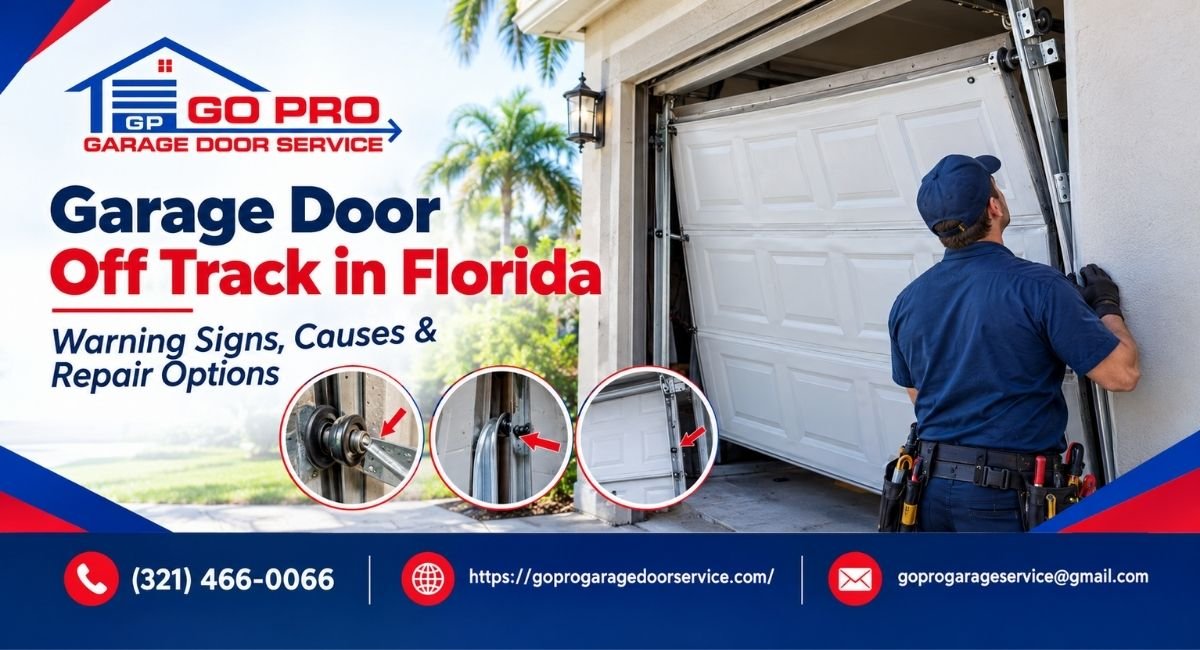
You press the button. The motor hums. The door rises a foot, tilts to one side, and stops. One corner hangs lower than the other, and a roller sits outside the track.
This is a garage door off track, and it is one of the most common mechanical failures homeowners face. It can happen after a storm, a bump from a car, or years of slow wear. It can also happen on a quiet Tuesday with no warning at all.
The first instinct is to push the door back into place. That is the move that turns a small repair into a large one. A door weighs a few hundred pounds, and it hangs on springs and cables that hold serious tension. One wrong push can bend the track, snap a cable, or drop the door.
This guide shows you how to read the problem before you touch anything. You will see the warning signs, the causes behind them, and how to tell a displaced roller from a bent track, a cable failure, or a structural misalignment. You will also learn what is safe to check, what to leave alone, and what a repair looks like, so you can decide with clear facts.
If your door is stuck right now, skip ahead to the safety section. Then come back and read the rest.
Warning Signs Your Garage Door Is Off Track
Some off-track doors announce themselves loudly. Others show smaller clues first. Catching those early can save the door from a full failure.
What you can see
- The door looks crooked. One side sits higher than the other, or the top corner leans away from the wall.
- A roller is out of the track. You can see the wheel sitting beside the track instead of inside it.
- There are gaps along the edges. Light shows between the door and the frame in uneven patches.
- The track looks bent or twisted. A kink, dent, or wave in the metal is a clear sign.
- Cables hang loose. Slack or a frayed cable often goes with a door that has dropped on one side.
- Panels bow or crease. A door that was forced can bend its panels.
What you can hear
- Grinding or scraping as the door moves
- A loud pop or bang, which often points to a cable or spring break
- Squealing from rollers that no longer turn freely
- A motor that strains or hums without moving the door
How the door behaves
- It jerks, sticks, or shudders partway up.
- It will not close fully, or it reverses before it hits the floor.
- It moves only a few inches, then stops.
- It feels much heavier than normal when you lift it by hand.
Opener clues
An opener that runs without lifting the door often means the door is not riding freely. The opener may also stop and reverse because it senses resistance. Do not keep pressing the button. Repeated attempts can twist the door and strain the opener arm.
For a wider list of early warnings that appear before a failure, see our guide to garage door repair signs.
Why a Garage Door Comes Off Track
A door runs inside two vertical tracks and two horizontal tracks. Rollers ride in those tracks, and lift cables and torsion springs control the weight. When any one part drifts out of position, the whole system can shift.
Impact and accidents
A car bumper or a swinging ladder can push a roller out of its track in a second. The door may look fine at first and fail the next time you use it. Even a light hit can bend a vertical track enough to cause trouble later.
Loose or worn hardware
Daily use shakes bolts loose over the years. A track that shifts a quarter inch can pinch a roller and push it out. Worn, cracked, or flat-spotted rollers also slip out more easily.
A broken or slack cable
Lift cables hold the bottom corners of the door. If one breaks or slips off its drum, that side drops, the door tilts, and the rollers can leave the track.
Spring problems
Springs balance the door. A worn or broken spring leaves the door heavy, and the opener then drags it. That uneven load can push rollers out of line.
Debris and obstructions
Small objects in the track stop a roller. Leaves, grit, hardened grease, and loose pebbles all count. Anything in the door’s path can have the same effect.
Opener force and misuse
An opener that pulls a stuck door can twist panels and bend tracks. Forcing the door by hand in the wrong direction has the same effect.
Florida conditions that add risk
Central Florida’s climate adds its own causes.
- Storm winds. Strong gusts push on the door and can flex tracks and pull wall brackets from the framing.
- Humidity. Constant moisture speeds up rust on tracks, rollers, and bolts.
- Wood rot and insects. Track brackets bolt into wood jambs. Soft, damaged wood no longer holds the bolts tight.
- Heat. Repeated heating and cooling can loosen hardware and dry out lubricants.
These factors rarely cause a single dramatic failure. They wear the system down until one ordinary day tips it out of line.
Displaced Roller, Bent Track, Cable Failure, or Misalignment?
The phrase “off track” covers several different faults. Each one has its own cause, risk, and repair. Telling them apart helps you judge how serious the problem is and who should fix it.
A displaced roller
This is the mildest case. One roller pops out of its track, usually near the top or bottom. The track itself stays straight, the cables stay tight, and the door sits only slightly crooked.
Signs: a single roller outside the track, little or no visible bend, and no loose cable. A pro can often reset it quickly, then check the track and hardware for the cause.
Bent trackwork
Here the track has lost its shape. It may have a dent from an impact, a twist from uneven force, or a bow from wind pressure. The rollers then jam or jump out.
Signs: a visible kink or wave, a gap between the track and the door edge that changes along its length, and scraping sounds. Rollers may pop out again after a simple reset because the bend remains. Minor bends can sometimes be straightened. Severe ones call for new track sections.
Lift cable failure
A lift cable carries the door’s weight at the bottom corners. When one slips from its drum or snaps, that side drops and the door tilts hard. Rollers often leave the track as the door twists.
Signs: a loose or frayed cable, a door hanging at a sharp angle, and often a loud bang beforehand. This case is dangerous because the cable and spring system hold stored energy. Our guide on how to repair a garage door cable explains why this repair belongs with trained technicians.
Structural misalignment
Sometimes the track is not the problem. The wall brackets or jamb behind it have shifted. Bolts may have pulled out of rotted wood, or the framing may have moved after a storm or settling. The track then sits out of line even if the metal is straight.
Signs: tracks that pull away from the wall, cracked or soft jamb wood, bolts that spin freely, and a door that goes out of alignment again after a reset. This fault needs a repair to the mounting, not just a nudge to the roller.
Quick comparison
| Fault | What you see | Risk level | Who should handle it |
|---|---|---|---|
| Displaced roller | One roller outside a straight track | Moderate | A technician, or a careful owner only in simple cases |
| Bent track | Dent, twist, or wave in the metal | Moderate to high | A technician |
| Cable failure | Slack or frayed cable, sharply tilted door | High | A technician only |
| Structural misalignment | Track pulling from the wall, loose or rotted jamb | High | A technician, sometimes with a carpenter |
More than one fault can exist at once. A broken cable may bend the track, and a bent track may wear the rollers. That is why a full inspection matters even when the problem looks simple.
Why Forcing an Off-Track Door Makes Things Worse
When a door is stuck, pushing or pulling it feels like the obvious answer. It rarely works. In most cases it adds damage.
The door is heavier than it looks
A typical residential door weighs a few hundred pounds. The springs carry most of that load. When the door is off track, the balance is gone, and the full weight may rest on a few points. Pushing against that load can bend metal and slip your grip.
Tracks are shaped for the rollers
The vertical and horizontal tracks join in a curve. Rollers must travel through that curve in a straight line. A roller forced back into the track at the wrong angle can bend the curve or chip the roller. The track may look repaired, then fail again on the next cycle.
Cables can jump or snap
If you force one side, you shift the load onto the cable on the other side. A worn cable may slip off its drum or break. That can drop the door suddenly.
The opener takes the hit
An opener is built to move a balanced door. When it fights a jammed door, it can strip gears, bend its arm, or burn out the motor. Our guide on how to fix a garage door opener covers these opener faults, but the best fix is to avoid causing them.
People get hurt
The injury risk is real. A door that drops, a spring that releases, or a cable that whips can cause serious harm. Hands can be pinched in tracks and hinges. That is why professionals use proper clamps, tools, and procedures.
A short example
A homeowner in Ocoee finds a roller outside the bottom of the track. A quick push seats it back, but the door catches halfway up. The homeowner tries again with the opener. The door twists, a panel creases, and the cable slips off its drum. What began as a single displaced roller now needs a track section, a new panel, and a cable reset. The extra cost came from the effort to fix it fast.
The lesson is simple. If the door is stuck, stop and inspect before you act.
What to Do Right Away: Safety Steps for a Stuck Door
The first few minutes matter most. Use this order.
- Clear the area. Keep people, pets, and vehicles away from the door. Do not stand or walk under a door that hangs open.
- Stop using the opener. Unplug it or switch off its breaker. Do not press the button again.
- Leave the emergency release alone if the door is partly open. Pulling the red cord on a door that is up and off track can let it fall.
- Do not touch springs, cables, or bottom brackets. These parts hold stored energy.
- Take photos. Show the roller, the track, the cables, and the overall angle of the door. Photos help a technician prepare, and they help with insurance if a storm caused the damage.
- Note what happened. Write down when it started, what you heard, and whether anything hit the door.
- Call for help. An off-track door leaves your garage open or unsafe to use, so call a technician soon.
Can you close a garage door that is off track?
In most cases you should not try. A door that is partly open and off track may jam, twist, or fall when it moves. Closing it forces the rollers through a bent or misaligned path and can damage the track and panels.
If the door is already closed, leave it closed until a technician looks at it. If it is open and you need to secure the garage, a professional can lower it safely using clamps and proper tools. Some companies treat this as an emergency call, which is worth asking about.
If a storm is coming
Florida weather can turn a small problem into a bigger one. A door that is off track cannot take wind pressure as well as an intact one. Call a technician before the weather arrives, and ask what temporary steps are safe for your door. Do not try to brace or prop it yourself.
How to Get a Garage Door Back on Track: When a Minor DIY Fix Is Reasonable
Some homeowners are comfortable with basic tools. A very small set of cases can be handled with care. Many cannot. This section shows how to tell the difference.
Check these conditions first
A DIY attempt may be reasonable only if all of these are true:
- The door is fully closed and sits on the floor.
- Only one roller is out, near the bottom.
- The track is straight with no dents or bends.
- Both lift cables are tight and in their drum grooves.
- The springs look intact, with no gap in the coil.
- The panels have no creases, and the hinges look sound.
- You have a helper, gloves, safety glasses, and a stable ladder.
If even one of these is untrue, stop. Call a technician.
Basic steps for a displaced bottom roller
- Unplug the opener so it cannot start.
- Clamp a pair of locking pliers onto each track just above the lowest roller. This blocks the door from rising.
- Clean the track of debris with a dry cloth.
- Check that the roller wheel turns freely and the stem is not bent.
- Guide the roller back into the track opening with gentle hand pressure. Do not hammer it.
- Check that the roller sits inside the track.
- Remove the clamps.
- Lift the door a few inches by hand and watch both sides. It should move smoothly. Lower it again.
- If the door runs freely, lift it halfway and let go with care. A balanced door stays near that point.
If the roller will not seat with light pressure, the track may be bent or misaligned. Stop and call a professional.
Do not do these things
- Do not loosen or tighten spring or bottom bracket hardware.
- Do not use the opener to pull the door back into place.
- Do not hammer a bent track flat.
- Do not work alone on a door that is open or partly open.
One roller out can still point to a deeper problem
A roller that slipped once usually had a reason. Check for loose bolts, worn rollers, or a spring problem. A professional garage door off-track repair in Orlando, FL covers the reset and a check of the surrounding parts, so the same roller does not slip out again next week.
What a Professional Off-Track Repair Involves
A good repair goes beyond putting a roller back. The goal is to fix the cause so the door stays on track.
The usual process
- Inspect and document. The technician checks the tracks, rollers, cables, springs, hinges, panels, and mounting points. They photograph the damage.
- Secure the door. Clamps and supports hold the door steady so it cannot fall or shift.
- Find the root cause. The technician looks for what pushed the door out of line: a bent track, a slipped cable, a weak spring, or a loose mount.
- Repair or replace the affected parts. This can mean resetting rollers, straightening a minor bend, replacing track sections, installing new rollers or hinges, re-anchoring brackets, or resetting cables.
- Rebalance the door. The technician tests the spring tension and adjusts it with proper tools.
- Test the full system. They run the door through its full travel, check alignment, and confirm the opener’s force settings and auto-reverse work.
If a spring turns out to be worn or broken, a professional broken spring replacement in Kissimmee FL often happens during the same visit. Springs and tracks affect each other, so it makes sense to address both.
Typical failure examples
The cases below are composites of problems technicians commonly see. They are not individual customer records. They show how different the root cause can be even when the symptom looks the same.
Example one: a bent vertical track after a car bump. A roller kept popping out near the middle of the left track. The reset worked for a few days, then failed again. The inspection showed a shallow dent in the track. The technician replaced that track section, swapped a flat-spotted roller, and tested the balance. The door has run smoothly since.
Example two: a snapped cable after a storm. The right side of the door dropped, and the top roller left the track. The cable had frayed for months, and storm vibration finished it. The twisted door also bent the lower track. The repair included a new cable, a new track section, and a full re-alignment.
Example three: a rotted jamb in a humid home. The track kept drifting out of line, and the bolts spun freely. Moisture had softened the wood jamb. A carpenter repaired the jamb, then the technician re-anchored the track and set the alignment. Replacing the track alone would not have fixed it.
What to ask before the work begins
- What caused the door to come off track?
- Which parts need replacement, and which can be repaired?
- Is the estimate in writing, with parts and labor listed?
- What warranty applies to the parts and the work?
- Will you test the balance and safety reverse before leaving?
Track Repair, Replacement, and New Doors on Old Tracks
Once the cause is clear, the next question is whether to repair the tracks or replace them. The answer depends on the damage and on the age of the rest of the door.
When track repair works
A minor bend near the end of a track can sometimes be straightened with proper tools. A technician may also replace only one damaged section. This works best when the rest of the track is straight, solid, and free of rust.
When to replace a bent garage door track
Replacement is the safer choice in these situations:
- The track has a kink, a twist, or a crease.
- The bend sits at the curve where the vertical and horizontal sections meet.
- Rust has thinned the metal.
- Both sides show damage.
- Repairs have already failed once.
- The track no longer matches the rollers or hinges.
A bent track that has been hammered flat often fails again. The metal has already lost its strength at that spot.
Can you install a new garage door on old tracks?
Sometimes, but not always. Old tracks can work only if their size and curve match the new door, they are straight and free of rust, and they are firmly anchored. Even then, many installers replace tracks along with the door.
There are good reasons. The door, tracks, rollers, hinges, and springs are designed to work as a matched system. New hardware also removes the risk that worn or mismatched parts cause the same failure again. In Florida, the wind rating of a door is tested for a complete assembly, so mismatched hardware can undercut that rating. Ask the installer what they recommend for your door and how they will confirm local code compliance.
Repair options at a glance
| Option | Fits best when | Limits to know |
|---|---|---|
| Reset the roller | The track is straight and only one roller slipped | Does not fix the cause if bolts, rollers, or springs are worn |
| Straighten a minor bend | The bend is small and the metal is sound | Weakened metal can fail again |
| Replace a track section | Damage is limited to one area | The section must match the existing track |
| Replace both tracks | Damage or rust is widespread | Costs more, but gives a matched, stable path |
| Re-anchor or repair the jamb | Bolts are loose or the wood is soft | May need carpentry work as well |
| Replace the door and hardware | The door is old, panels are creased, or parts are mismatched | Higher upfront cost, with a fresh matched system |
Planning for a new door
If your door is old and several parts are damaged, replacement can be the better use of money. A new door and hardware set gives you a matched system and a fresh warranty. A professional garage door installation in Windermere FL also includes anchoring, balancing, and a safety test, which protects the investment.
How to Keep Your Garage Door on Track in Florida
Most off-track failures give warnings first. A few simple habits catch them early.
Monthly checks
- Watch the door run. Look for jerks, tilts, and unusual noises.
- Look at the tracks for dents, rust, and debris.
- Check that the rollers sit snugly in the tracks.
- Look at the cables for fraying or slack.
- Make sure nothing is stored where the door can hit it.
Seasonal care for Florida homes
- Before hurricane season, tighten loose bolts and check the wall brackets and jamb.
- After heavy storms, inspect the tracks and mounting points even if the door seems fine.
- In humid months, wipe tracks clean and look for rust on rollers and hinges.
- Each year, have a technician check balance, springs, and cables.
For a full routine, use our garage door maintenance checklist. It lists the parts to check and how often.
Habits that protect the door
- Park well clear of the door and use a clear path.
- Do not hang items from the tracks or the door.
- Avoid using the opener when the door feels stuck.
- Keep children away from the tracks and the door’s moving parts.
- Replace worn rollers and hinges before they fail.
Consider a tune-up
Small problems add up. A technician can find a loose bracket, a worn roller, or a weakening cable before it pushes the door off track. A professional garage door tune-up in Florida is a low-cost way to catch these issues while they are still simple.
Garage Door Off Track FAQs
Why does a garage door come off track?
Common causes include impact from a car, loose or worn hardware, a broken cable, spring problems, debris in the track, and opener force. In Florida, storm winds, humidity, and soft wood around the jamb add more risk.
Can you close a garage door that is off track?
It is not safe to try in most cases. Forcing the door can bend tracks, crease panels, and drop the door. If the door is closed, leave it closed. If it is open, keep people clear and call a technician.
How do I get my garage door back on track?
Only a simple case is suitable for DIY: the door fully closed, one bottom roller out, a straight track, tight cables, and intact springs. Even then, work with a helper and stop if the roller will not seat with light pressure. Anything else calls for a professional.
How do I fix a garage door that came off track on one side?
A door that hangs from one side often has a broken or slipped cable, or a spring problem. Do not touch the cable or springs. Keep the area clear, unplug the opener, and call a technician.
Can I use the opener to pull the door back into place?
No. The opener is made to move a balanced door on a straight track. Using it on a stuck door can twist panels, strip gears, and damage the motor.
When should I replace a bent garage door track?
Replace the track when it has a kink, a twist, or a crease, when the bend sits at the curve, when rust has thinned the metal, or when a repair has already failed. Hammering a bent track flat often shortens its life.
Can you install a new garage door on old tracks?
Sometimes, if the tracks match the new door, run straight, show no rust damage, and are well anchored. Many installers replace tracks anyway, because the door and hardware work best as a matched system, and wind ratings apply to complete assemblies.
Is an off-track door an emergency?
It can be. A door stuck open leaves the garage unsecured, and a door hanging from one side may fall. If it is stuck open or the weather is turning, treat it as urgent and call for service.
Inspect First, Then Decide
An off-track garage door looks simple, but the cause can sit deeper. A displaced roller, a bent track, a failed cable, and a shifted jamb each call for a different repair. Pushing the door back into place without a plan often adds damage and puts you at risk.
Stop using the opener. Keep the area clear. Take photos and write down what happened. Then decide whether the case is simple enough for a careful check or needs a professional. When a cable, spring, or bent track is involved, a trained technician is the safer choice.
Need help with a garage door off track?
Go Pro Garage Door Services helps homeowners in Orlando and across Central Florida with off-track repair, track replacement, cable and spring work, and new door installation. A technician will find the cause, explain it in plain terms, and give you a written estimate before work begins.
Ready to get your door moving again? Visit our garage door services page to book a visit or request a quote.