The storm passed overnight. The lights are out. Your car is in the garage, and you need to leave for work.
You press the wall button. Nothing happens. You press the remote. Nothing again.
This is a common morning in Florida. Hurricanes, summer thunderstorms, and grid repairs can cut power for hours or days. A standard garage door opener stops working the moment the power stops. The door itself still works. It just needs to be moved by hand.
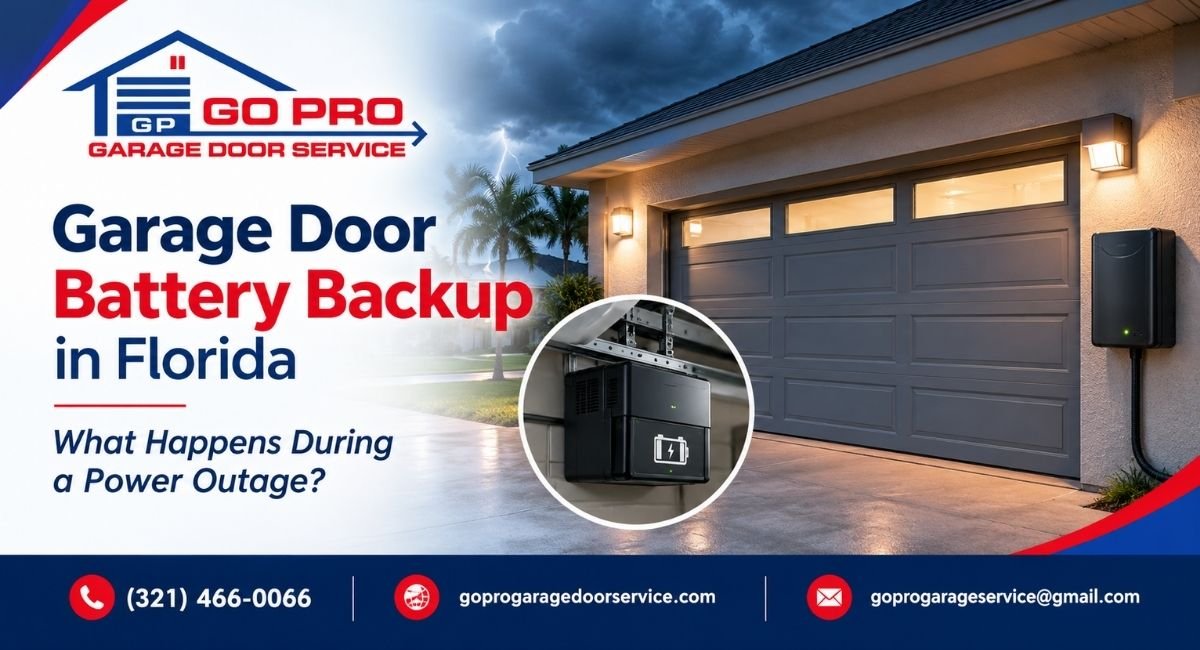
Some homes have a second option. A battery backup keeps the opener running on stored power. The door opens and closes with the push of a button, even in the dark.
This guide explains what happens to your garage door during a power outage. It compares battery backup with manual release, covers verified specifications from LiftMaster, Chamberlain, and Genie, and explains opener compatibility. It also shows how to open a door safely by hand and when to call a professional. A decision guide at the end helps Florida homeowners choose.
The team at Go Pro Garage Door Services works on garage doors and openers across Central Florida. The advice below comes from the issues that show up on real service calls.
What Happens to a Garage Door When the Power Goes Out
An automatic opener is a motor that pulls the door along a track. It needs electricity to run the motor, the control board, the lights, and the safety sensors. When the power fails, all of these stop.
Without a battery backup
The door stays in whatever position it was in. The wall button and remotes do not respond. Keypads and smart controls go offline too.
The door can still be moved by hand. Every opener has an emergency release. It disconnects the motor from the door so you can lift it manually. This works well when the springs are healthy. Springs carry most of the door’s weight, so a balanced door feels fairly light.
With a battery backup
When the grid goes down, the opener switches to its battery. The switch is automatic. You press the button as usual. The door opens and closes, though many owners notice it moves a little slower on battery power. Safety sensors and security features keep working.
The battery is not unlimited. Each brand rates it for a set number of open and close cycles. After that, the door needs manual operation or restored power.
Why this matters in Florida
Florida outages are not rare events. Hurricane season runs from June through November. Afternoon storms can knock out a neighborhood feeder line in minutes. After a major storm, repairs can take days.
Three situations make the backup worth thinking about:
- Evacuation. You may need to move a car quickly, with no time to wrestle a heavy door.
- Mobility limits. Older adults and people with injuries may not be able to lift a door by hand.
- Security. An open or half-opened garage after a storm is an easy way into the home.
A battery backup does not replace safe manual skills. It adds a second layer.
Battery Backup vs Manual Release: How They Compare
These are not competing systems. Every garage door should have a working manual release. A battery backup is an optional add-on. The real question is whether manual release alone is enough for your household.
How manual release works
The red cord hangs from the opener rail. Pulling it disconnects the trolley from the door. You then lift the door by hand. To reconnect, you pull the cord back toward the opener and run the opener through a cycle.
Strengths of manual release:
It costs nothing and is built into every opener. It does not depend on a battery or its age. It works for any outage length.
Limits of manual release:
It needs physical strength and a balanced door. The cord can be hard to reach if a car is parked under the opener. It is risky if a spring or cable is damaged. While the opener is disconnected, the motor’s security function is also off.
How battery backup works
The backup battery sits inside the opener or in a slide-in compartment. It charges while the opener has power. When the grid fails, the opener draws from the battery and runs as normal.
Strengths of battery backup:
You use the same button or remote you use every day. Heavy doors are no issue. Safety sensors keep working.
Limits of battery backup:
Capacity is limited by the battery. Batteries wear out and need replacement. Not every opener supports one. Extreme heat can reduce performance.
The practical answer
Most Florida homes benefit from having both. Use the battery for convenience and the manual release as the last resort. If your opener has no battery, make sure everyone who drives knows the release procedure and the door is in good balance.
A door that does not feel balanced may have a spring problem. A broken spring replacement in Florida should be done by a trained technician before you rely on any manual method.
What to Expect From Battery Backup Operation
A battery backup is rated in cycles. One cycle means one full open and one full close. The rating tells you how many times the door can run before the battery is drained.
Manufacturer specifications
The table below summarizes published figures for the three brands homeowners ask about most. Figures come from manufacturer-supplied product descriptions and Genie’s own product page. Ratings are maximums under good conditions, and they vary by model and year.
| Brand and model | Backup power source | Stated backup capacity | Other notes |
|---|---|---|---|
| Chamberlain (4228 replacement battery) | 12V, 4.5 Ah sealed AGM lead-acid battery | Up to 20 cycles without grid power | Recharges automatically, and safety and security features keep working |
| LiftMaster (485LM battery for DC models such as 8500, 8500W, 8550W, 8360) | 12V sealed lead-acid battery | Up to 20 cycles in many listings | Slide-in or integrated, depending on model |
| Genie (StealthDrive 750 and StealthDrive Connect) | Integrated backup battery | Up to 50 cycles from the initial power failure | One year warranty on the battery, switch to battery is instant |
Reading the numbers
Twenty cycles sounds like plenty. For a household with one car, it is. Ten round trips fit in the first day. A family with several drivers, or a household that opens the door often, can use it up faster.
One door manufacturer’s guidance adds a useful detail. A fully charged battery is designed for about 24 hours of standby, with up to 20 cycles, at room-range temperatures of roughly 60 to 70 degrees Fahrenheit. It also notes a recharge time of around four and a half hours once power returns. Florida garages often run hotter than that range in summer, so treat the rated cycle count as a best case.
Genie’s rating of up to 50 cycles is higher. That figure applies to its integrated systems on the models listed. Always check the manual for your exact opener.
What the door does on battery
Expect these behaviors:
- The door may open and close more slowly than usual.
- Safety sensors stay active, so a blocked beam still stops the door.
- The opener may chirp or beep when the battery is low or failing.
- Courtesy lights may work or may be limited, depending on the model.
- Smart features may stop. Wi-Fi routers lose power too, so phone control often fails unless your router has its own backup.
How long the battery lasts
Batteries wear out even if you never use them. Many sources put the typical life of a sealed lead-acid backup at two to three years. Heat shortens it. A persistent chirp from the opener is the usual warning. Replacement batteries at retail listings commonly run roughly $40 to $70, depending on the model and seller.
A simple test helps. Unplug the opener and cycle the door a few times. If it runs, the battery works. Plug it back in so it recharges.
Compatibility: Which Openers Support Battery Backup?
Not every opener can take a battery. Compatibility depends on brand, motor type, and model year.
Brand rules
Batteries are brand and model specific. A battery made for one brand does not fit another brand’s opener. Chamberlain, LiftMaster, and Craftsman openers come from the same family, and listings for the 4228 battery name all three. Even so, confirm the part number in your manual or on the old battery before you buy.
Genie handles backup differently on its main models. The StealthDrive 750 and StealthDrive Connect have the battery built in. You replace it through Genie parts channels.
Motor type
Battery backup is tied to DC motor openers. Many older chain-drive openers use AC motors and have no backup option. If your opener is more than 15 years old and has no battery compartment, you usually cannot retrofit one. The practical path is to replace the opener.
Common compatible LiftMaster models
Reseller listings for the 485LM battery name the LiftMaster 8500, 8500W, 8550W, 8360, and 8360W. A similar slide-in battery is listed for older units such as the 3850. Treat these lists as a starting point. Your model number is on the opener’s side label.
Door size and weight
Battery backup does not change what the opener can lift. Genie lists its StealthDrive 750 for sectional doors up to 7 feet high and up to 500 pounds. An 8 foot door may need an extension kit. A heavy or out-of-balance door strains any motor, battery or not.
Quick compatibility check
Before you shop, gather three things:
- The opener brand and model number.
- The age of the opener.
- Whether the opener has a battery compartment or a backup label.
With those three facts, a technician can tell you in minutes whether a battery fits or a new opener is the better route.
How to Open a Garage Door During a Power Outage
If your opener has no battery, or the battery is spent, use the emergency release. The steps are simple. The safety rules matter more than the steps.
Step by step
- Make sure the door is fully closed. If it is stuck partway, stop and call a technician.
- Look for the red cord that hangs from the opener rail.
- Pull the cord straight down once. You should hear or feel the trolley disconnect.
- Lift the door slowly by hand. Keep your hands clear of the track and the section joints.
- Hold or prop the door open if you plan to leave it open for a time.
- When power returns, close the door by hand, then reconnect the trolley by pulling the cord toward the opener. Run the opener through one full cycle to confirm it latches.
Some openers use a lever on the carriage instead of a cord. Some garages also have an outside key release near the top of the door. Many do not.
Safety rules to follow every time
Never pull the release while the door is open or moving. A door that is held up only by the opener can fall when the opener lets go. This is a leading cause of injury.
Do not allow children to use the cord. Do not hang items on it. Do not yank it hard, since the cord can snap.
Stay out from under the door while it moves.
If the door feels too heavy
A balanced door feels light after release. If it is hard to lift or slams down, a spring may be broken or a cable may be loose. Do not force it. Garage door springs hold very high tension. Repairs should be handled by trained technicians, not by homeowners.
If the door will not move at all and your car is inside, call for help. A professional can secure the door and free the vehicle without damage.
Reaching the cord with a car inside
Many homeowners park right under the opener. The cord can be hard to reach from a parked car. Check this before storm season. Extend the cord to a comfortable height, but keep it away from the roof of tall vehicles so it does not snag. A technician can move the cord or add an outside release if your garage has no side door.
After the outage
When the grid returns, do not rush the opener. Inspect the door first. Look for bent tracks, loose hardware, and frayed cables. A garage door tune-up services after a major storm is cheap protection against a bigger failure later.
Florida Outages, Hurricane Season, and Battery Care
Florida’s climate puts extra stress on backup batteries and on the doors they serve. A few habits keep the system ready.
Heat and humidity
Sealed lead-acid batteries age faster in heat. Garages in Orlando, Kissimmee, and across Central Florida can run very hot in summer, shortening battery life below the typical two to three years. Humidity can also corrode terminals and plugs. When replacing the battery, check these components and consider residential garage door drum repair services in Orlando if you notice issues with your garage door’s operation.
A pre-season checklist
Go through this list in May, before hurricane season begins:
- Unplug the opener and run the door through three cycles on battery. This confirms that the battery works.
- Replace any battery that chirps, is more than three years old, or fails the test.
- Check the red release cord. It should hang freely and be reachable.
- Confirm everyone who drives knows the manual release steps.
- Test the door balance with the opener disconnected. It should stay roughly in place when lifted halfway.
Battery backup does not make a door storm-ready
This point surprises many owners. A battery backup helps you move the door. It does not make the door resist wind. In a hurricane, the garage door is one of the weakest points in the home. If you are preparing for a named storm, a door rated for high winds matters more than a battery. Go through the guide on hurricane-resistant garage door materials in Florida to see how materials and bracing differ.
Before a storm, move vehicles you plan to use. Close the door and leave it closed. Do not open it during high winds.
Generators and the garage
Some homeowners run a generator after a storm. A generator can power an opener if it is connected through a proper transfer switch or an approved method. Never run a generator inside a garage, even with the door open. Exhaust contains carbon monoxide, which can enter the home. Keep generators outside and well away from doors and windows.
Surge protection
Power often returns with surges. A surge can damage the control board and charging circuit. A surge protector on the opener outlet is a low-cost safeguard.
Battery Backup Installation Cost and When to Hire a Professional
Cost depends on whether you need only a battery or a new opener.
Typical cost ranges
There are three common paths:
- Replacing a slide-in battery. Retail listings for common replacement batteries commonly run roughly $40 to $70.
- Adding a battery to a compatible opener. One door manufacturer’s older guidance put an add-on unit near $100. Prices have changed since, so use that only as a rough reference.
- Buying an opener with backup built in. The same guidance put the extra cost for an integrated battery at about $50 to $60 over a model without one. Current openers with backup and smart features cost more overall.
Labor is separate and varies by home. For wider cost context, the guide on garage door installation cost breaks down what drives price.
What a homeowner can do
Swapping a slide-in battery is a reasonable DIY task for many people. The usual process is to disconnect power, remove the battery cover with a screwdriver, switch the battery, reconnect the wires, and replace the cover. Always follow your model’s manual. Use the correct part number.
When professional installation is needed
Call a professional in these cases:
- Your opener has no battery compartment and you want backup added.
- You are replacing the opener to get backup.
- The door is heavy, oversized, or out of balance.
- You hear grinding, see frayed cables, or suspect a spring problem.
- The opener has wired accessories or smart controls that need setup.
- You want warranty coverage preserved.
A new opener works best on a sound door. A technician checks balance, track alignment, springs, and safety sensors as part of a proper job. Professional garage door installation services also includes setting the travel limits and force settings so the door reverses correctly when blocked.
Skipping this check can lead to opener burnout. A battery will not fix a door that is already working too hard.
Florida Homeowner Decision Guide
Use this table to match your situation to a sensible next step.
| Your situation | Best fit | Reason |
|---|---|---|
| Newer DC opener with a battery compartment | Test and replace the battery as needed | Lowest cost and quickest fix |
| Opener works well but has no battery option | Keep manual release, practice it, plan an upgrade | Retrofit is not possible on many models |
| Opener older than about 15 years | Replace with a model that includes backup | Old openers often lack backup and parts |
| Heavy door or household member with limited strength | Opener with battery backup | Manual lifting is hard and risky |
| Evacuation planning each hurricane season | Battery backup plus a rehearsed manual plan | Two layers cover a long outage |
| Heavy use of smart controls | Battery backup plus a router backup | Phone control needs Wi-Fi power |
| Garage with no side door | Battery backup plus an outside release | You must be able to get in |
How to use the table
Start with your opener’s age and model. That one fact narrows most choices. Then think about who lives in the home and how they would handle a door that does not move.
If you are shopping for a new opener, compare cycle ratings. Genie states on its StealthDrive 750 product page that the backup runs up to 50 cycles from the initial power failure. Chamberlain-family models list up to 20. A higher number gives more breathing room, but it is not the only factor. Motor type, noise, door size, and warranty matter too.
Let’s Assume
A Winter Park family with a 2012 opener. The opener has a slide-in battery that chirps. They replace it before June and test it. Total cost is a battery and fifteen minutes.
A Kissimmee retiree with a heavy two-car door. Lifting is a struggle. A new opener with backup gives push-button access during outages. A technician also checks the door balance first.
A Lake Mary home with a 20-year-old chain opener. There is no backup option. The owner replaces the unit with a DC belt drive model that includes a battery, and has the door tuned at the same time.
Common Questions About Garage Door Battery Backup
What happens to my garage door when the power goes out?
Without a battery, the opener stops and the door stays where it is. You can disconnect the opener with the emergency release and move the door by hand. With a battery backup, the opener switches to battery power and works as normal for a limited number of cycles.
How do I open a garage door during a power outage?
With the door fully closed, pull the red release cord straight down once. Then lift the door slowly by hand. Never pull the cord while the door is open or moving. If the door is very heavy, stop and call a technician, since a spring may be broken.
How many times can a battery backup open the door?
It depends on the brand and model. Chamberlain-family listings cite up to 20 cycles. Genie states up to 50 cycles on its StealthDrive 750 and Connect models. These are best-case figures, and heat and battery age reduce them.
How long does a garage door backup battery last?
Many sources put the typical life at two to three years. Florida heat can shorten it. A chirp from the opener usually signals that the battery needs replacing.
Can I add a battery backup to any opener?
No. Backup is tied to DC motor openers with a battery option. Many older AC chain-drive openers cannot take one. Check your model number, or ask a technician.
What is the best garage door opener battery backup for Florida homes?
No single model fits every home. Look for a DC motor, a higher cycle rating, a quiet belt or chain drive that suits your door, and a warranty you can verify. Heat tolerance and easy battery access also help in Florida garages. Match the opener to your door’s size and weight.
Will a battery backup work with smart garage controls?
The door will open on battery from the wall button and remotes. Phone and voice control often stop, because the home Wi-Fi router also loses power. A small battery backup for the router can keep smart controls running.
Is battery backup installation something I can do myself?
Replacing a slide-in battery is a reasonable DIY task if you follow the manual. Adding backup to a new opener, replacing an opener, or working on a door with balance problems should be done by a professional.
Does a battery backup protect the door in a hurricane?
No. It helps the opener run. It does not add wind resistance. For storms, focus on a wind-rated door and proper bracing, and keep the door closed during the storm.
Next Steps Before the Next Outage
A garage door that fails in the dark is a small problem that feels big. The fix is mostly preparation.
Here is a short plan:
- Find your opener’s brand, model, and age.
- Check whether it has a battery compartment or integrated backup.
- Test the battery by unplugging the opener and cycling the door.
- Replace the battery if it chirps or is more than three years old.
- Practice the manual release with the door closed. Check that the cord is reachable.
- Book a technician if the door feels heavy, noisy, or uneven.
If your opener has no backup option, or if you are planning a replacement, Go Pro Garage Door Services can inspect the door, confirm compatibility, and install an opener that fits your home and your budget. For reliable automated doors in Florida, trust professional installation and service to help keep your garage door operating smoothly. Call ahead of hurricane season, when schedules fill fast.
A working battery and a rehearsed manual plan together give you the best protection. Do not wait for the next storm to find out which one you have.
Contact Go Pro Garage Door Services to schedule an inspection or a battery backup upgrade.