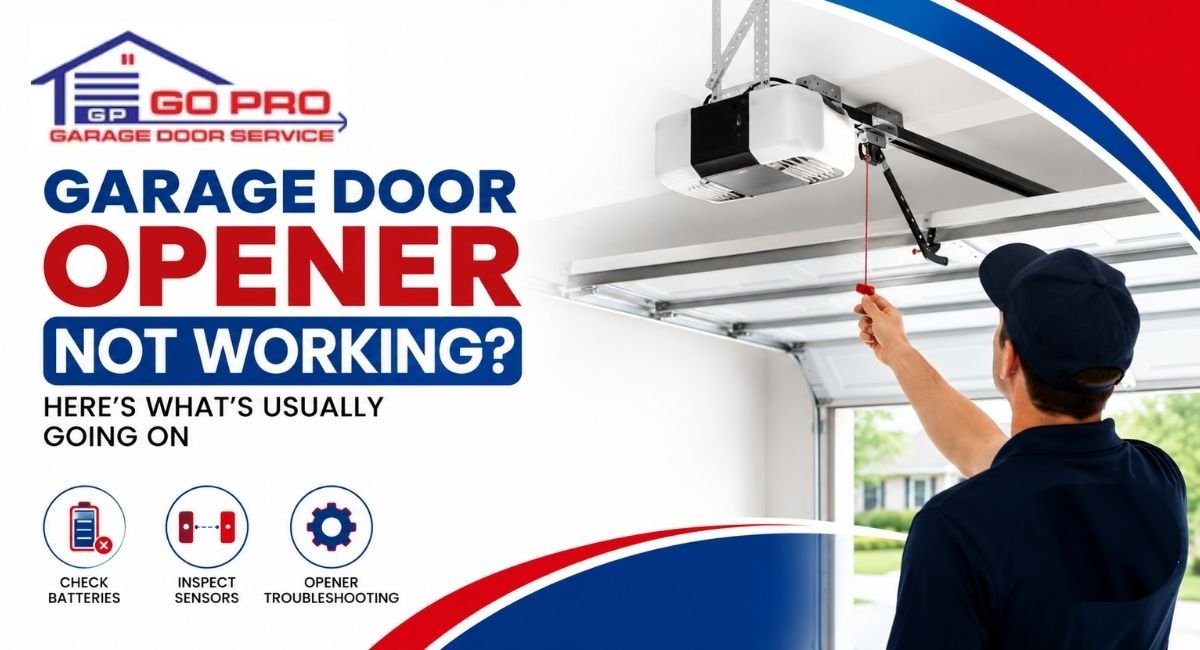
If your garage door opener not working has suddenly interrupted your routine, you’re not the first person dealing with it and you definitely won’t be the last. We get these calls all the time from homeowners and business owners who say the same thing: “It was working fine yesterday… and now nothing.”
In most cases, the opener isn’t “randomly broken.” It usually gives small warning signs first, but they’re easy to miss until the system finally stops responding.
Let’s go through what we typically see in real service calls and what you can actually check before assuming the worst.
Check the Simple Stuff First
You’d be surprised how often the issue is something basic.
Before assuming there’s a major failure, take a quick look at:
- Remote batteries (this is number one)
- Wall button response
- Power outlet / breaker
- Any loose plug at the opener
We’ve been on jobs where homeowners were already preparing for a full replacement, and it turned out to be a tripped breaker or a dead remote battery.
It sounds too simple, but it happens daily.
For routine issues like this, a quick garage door tune-up often prevents repeat problems before they start.
When You Try to Fix Garage Door Opener Issues, Sensors Are Often the Real Problem
One of the most common reasons people think they need to fix garage door opener systems is actually because of safety sensors.
These small sensors near the bottom of the tracks are extremely sensitive. Even a slight misalignment can stop the entire system from working correctly.
Common sensor-related problems include:
- One sensor blinking while the other stays solid
- Dirty lenses blocking the infrared beam
- Misaligned brackets after minor impact
- Sunlight interference in certain garage directions
- Loose wiring or corrosion
When sensors fail, the door may refuse to close or reverse immediately after touching the ground. A quick cleaning or realignment often restores normal function.
If sensor issues are frequent, it may be part of a bigger wear pattern that overlaps with garage door repair services in Orlando FL where we handle full system diagnostics.
A Malfunctioning Garage Door Opener Isn’t Always the Opener Itself
This is where most homeowners get misled.
When a garage door suddenly feels heavy or won’t lift properly, the opener usually gets blamed. But in reality, the opener is just doing its job, it’s the springs that carry the real weight.
So when a spring breaks, you’ll notice:
- Door feels extremely heavy manually
- Opener hums but doesn’t move the door
- Door only lifts a few inches and stops
- Loud snap from the garage (in many cases)
At that point, forcing the opener is the worst thing you can do. The system is already under stress.
This is where services like broken spring replacement become necessary before any opener repair even makes sense.
What a Failing Garage Door Opener Motor Feels Like
When the issue is actually the garage door opener motor, the behavior is usually more gradual.
It doesn’t just stop one day without warning. Instead, you’ll notice things like:
- Slower opening than usual
- Strange grinding or humming sounds
- Intermittent working (sometimes yes, sometimes no)
- Overheating after a few cycles
- Weak lifting power
In older units, the motor simply wears down over time. Sometimes it’s repairable, but often it’s more practical to replace the unit rather than keep patching it.
Troubleshooting Garage Door Openers the Right Way
Before replacing anything, proper troubleshooting garage door openers helps narrow down the exact cause.
Here’s a practical step-by-step approach:
1. Test the wall button and remote separately
If wall button works but remote doesn’t → remote issue
If neither works → power or system issue
2. Use the manual release
Pull the emergency cord and lift the door manually.
- Smooth movement → opener likely at fault
- Heavy or stuck door → springs or hardware issue
3. Observe the opener’s behaviour
- Humming but no movement → motor or drive issue
- Clicking sound only → electrical/relay problem
- No response at all → power failure
4. Inspect visible hardware
Look for:
- Loose brackets
- Bent tracks
- Debris in rollers
- Obstructions in the path
If the door is off track or struggling mechanically, garage door off-track repair may be required instead of opener repair.
Comparison: What’s Actually Causing the Problem?
| Symptom | Likely Cause | What It Means |
| Remote works, wall button doesn’t | Wiring or wall switch issue | Localized electrical fault |
| Opener hums but door doesn’t move | Broken spring | Door is too heavy for opener |
| Door reverses immediately | Sensor misalignment | Safety system is blocking closure |
| No response at all | Power failure or motor issue | Opener not receiving power |
| Intermittent operation | Worn motor or board | System nearing failure |
When Replacement Parts Are Enough
Not every issue means replacing the entire system.
In many cases, garage door opener replacement parts can bring everything back to normal, especially if the opener is still relatively modern.
Parts we commonly replace include:
- Drive gears
- Belts or chains
- Sensors
- Capacitors
- Circuit boards
- Trolleys
If the motor is still strong, a targeted repair usually makes sense.
For cable-related issues that often get mistaken for opener failure, see garage door cable repair.
But once the opener starts breaking repeatedly, it’s usually a sign the system is reaching its limit.
At Some Point, Upgrading Makes More Sense
Older openers can technically still run, but they often lack the safety and convenience features people expect today.
A new garage door opener kit can give you:
- Quieter operation
- Better security encryption
- Smartphone control
- Backup battery power
- Smoother start/stop motion
We’ve seen plenty of cases where customers spent years repairing an old unit when a replacement would’ve actually saved them money in the long run.
Full system upgrades are often handled during garage door installation when homeowners decide to modernize everything at once.
DIY vs Professional Repair (Quick Reality Check)
| Task | Safe DIY? | Why |
| Battery replacement | Yes | Simple and low risk |
| Sensor cleaning | Yes | Basic maintenance |
| Resetting opener | Yes | No mechanical risk |
| Spring repair | No | High tension danger |
| Cable work | No | Injury risk |
| Motor repair | No | Electrical + mechanical complexity |
Anything involving tension systems should be left to professionals. These systems store a lot of force and fail suddenly when handled incorrectly.
For reference, many of these issues overlap with garage door repair in Deland FL and nearby service areas where we handle emergency calls.
Keeping Your Opener from Failing Early
A little maintenance goes a long way here. Most breakdowns we see could’ve been delayed with simple care.
A few habits that help:
- Lubricate moving parts every few months
- Keep tracks clean
- Tighten loose brackets when needed
- Test safety sensors regularly
- Listen for new or unusual noises
A structured routine like this is covered in our garage door maintenance checklist.
When to Call for Help
If your garage door opener is not working, the issue keeps coming back, or the door behavior is unpredictable, it’s time to have it checked properly.
At Go Pro Garage Door Service, we deal with these exact situations every day across garage door services in Orlando FL and surrounding areas, from quick fixes to full system replacements.
Sometimes it’s a small adjustment, sometimes it’s a failing garage door opener motor, and sometimes the system just needs to be upgraded.
Either way, getting it checked early usually prevents bigger repair costs and unexpected breakdowns later on.
FAQs
Why is my garage door opener not working but has power?
This is often caused by sensor issues, remote failure, or internal control board problems.
Can a garage door opener motor be repaired?
Sometimes yes, but if the motor is old or heavily worn, replacement is usually more reliable.
How do I know if it’s the opener or the springs?
If the door is very heavy to lift manually, it’s likely a spring issue, not the opener.
What’s the average lifespan of an opener?
Most systems last around 10–15 years depending on usage and maintenance.
Is it worth repairing an old opener?
If breakdowns are becoming frequent, replacement is usually the smarter long-term option.
Need Help Getting It Fixed?
Garage door opener not working? If your garage door opener is giving you trouble, we can take a look and tell you exactly what’s going on, no guesswork, no unnecessary replacements.
From garage door services in Sanford, FL, to garage door repair in Orlando FL, to full system upgrades, Go Pro Garage Door Service handles repairs, replacement parts, and full opener installations for homeowners and businesses who just want things working properly again.
Get fast help, clear answers, and a repair that actually lasts.