A garage door that suddenly hangs crooked, refuses to open properly, or makes loud grinding noises is more than just an inconvenience. In many cases, the real problem is hidden in plain sight: a damaged or disconnected garage door cable. While the opener may still try to lift the door, a faulty cable can make the entire system unsafe to operate.
If you are searching for how to fix garage door cable, you are probably dealing with one of these frustrating situations. The good news is that some cable issues can be identified and corrected safely when they involve a cable that has slipped off the drum or become slightly loose. However, if the cable has snapped or the torsion spring remains under tension, the repair becomes much more dangerous and requires extra caution.
This guide explains how garage door cables work, why they fail, how to inspect them safely, and the seven steps involved in fixing a garage door cable when conditions allow. You will also learn when a repair is no longer a safe DIY project and when professional help is the smarter option.
Whether you own a sectional garage door with torsion springs or an extension spring system, understanding the basics will help you avoid costly mistakes while protecting your garage door from further damage.
Why Garage Door Cables Matter
Garage door cables are one of the hardest working components in the entire lifting system. They support the weight of the door every time it opens or closes and work together with the springs to create a balanced lifting force.
Without properly functioning cables, the springs cannot do their job effectively. Even a powerful automatic opener is not designed to lift the full weight of a garage door without assistance from the cables and springs.
A standard residential garage door can weigh anywhere from 130 to over 400 pounds depending on its size and material. The cables help distribute this weight evenly, keeping the door level throughout its movement.
When one cable fails, several problems can happen quickly:
- The door becomes uneven.
- One side lifts higher than the other.
- The rollers may jump out of the track.
- The opener experiences excessive strain.
- The door can suddenly fall without warning.
This is why fixing garage door cable problems should never be delayed.
How Garage Door Cables Work
Before attempting any repair, it helps to understand the basic system.
Most residential garage doors use one of two spring systems.
Torsion Spring System
This is the most common setup found on modern homes.
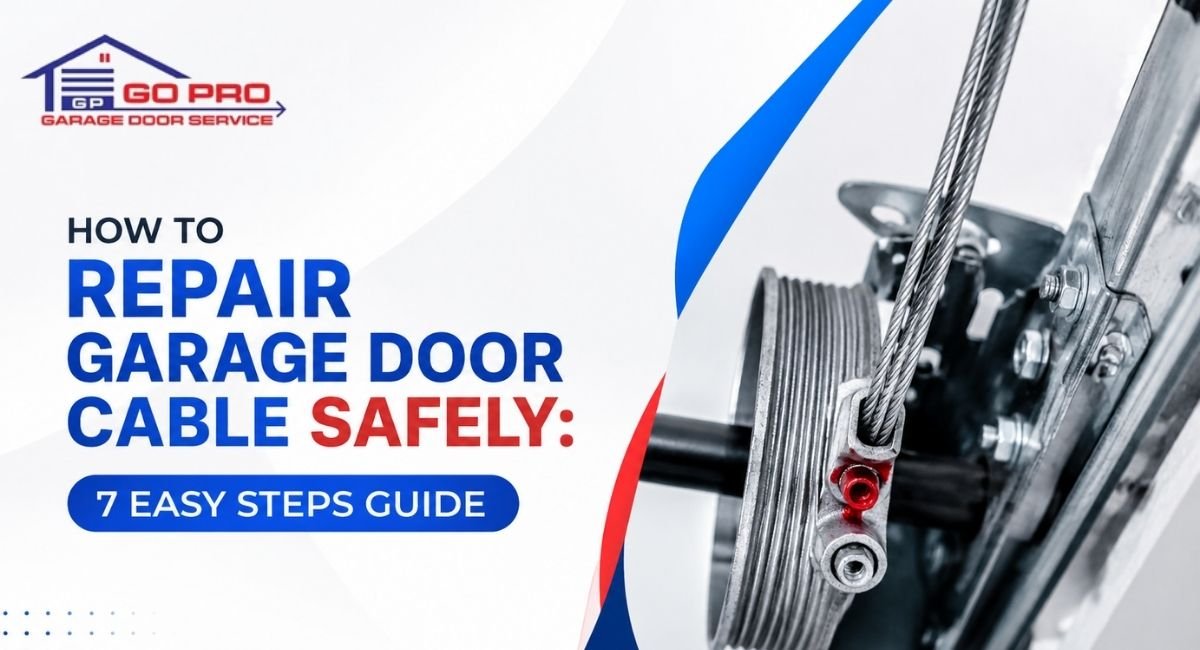
The torsion spring sits above the garage door. Steel cables attach to the bottom brackets on both sides of the door and wrap around cable drums mounted at each end of the torsion shaft.
As the door opens, the springs unwind while the cables wrap neatly around the drums, lifting the door evenly.
Extension Spring System
Older garage doors often use extension springs mounted alongside the horizontal tracks.
In these systems, cables pass through pulleys that help balance the door as the springs stretch and contract.
Although the two systems operate differently, both rely on properly installed cables for safe operation.
Signs Your Garage Door Cable Needs Repair
Not every garage door problem starts with the springs. Often, the cables provide the first warning.
Look for these symptoms.
The Door Looks Crooked
One side opens normally while the other remains lower.
This usually indicates that one cable has slipped, stretched, or broken.
Loose Cable Hanging Beside the Door
If you notice a cable dangling near the track, stop using the opener immediately.
The cable may have come off the drum or completely snapped.
Door Gets Stuck Halfway
A cable that has partially unraveled often causes uneven lifting.
Loud Popping or Scraping Sounds
Grinding noises can indicate cable misalignment or damaged drums.
Frayed Steel Strands
Inspect both cables closely.
If you see broken wires sticking out, the cable has reached the end of its service life.
The Opener Struggles
If your opener suddenly sounds strained, disconnect it and inspect the lifting system before continuing.
Ignoring these warning signs often leads to broken garage door cables, damaged rollers, bent tracks, or failed openers.
Why Garage Door Cables Break
Garage door cables rarely fail without a reason.
Several factors contribute to premature wear.
Normal Wear
Every opening and closing cycle slowly weakens the steel strands.
Most residential cables last between 8 and 15 years depending on usage.
Rust and Corrosion
Moisture is one of the biggest enemies of steel cables.
Rust weakens individual strands until they eventually snap.
Improper Spring Tension
If the torsion spring loses balance, the cables absorb additional stress.
Over time they stretch or unravel.
Poor Installation
Improper cable routing can cause rubbing against drums or brackets.
Eventually the cable frays.
Impact Damage
Accidentally striking the bottom bracket with a vehicle or heavy object may knock the cable off its drum.
Lack of Maintenance
Simple annual inspections often catch worn cables before complete failure occurs.
Following a regular maintenance schedule like the one outlined in the Garage Door Maintenance Checklist can significantly extend the lifespan of your garage door components:
Can You Fix a Garage Door Cable Yourself?
This is one of the most common questions homeowners ask.
The answer depends entirely on the condition of the cable and the spring system.
Generally, DIY repairs are safer when:
- The cable has slipped off the drum.
- The torsion spring remains intact.
- The garage door is fully closed.
- You understand the lifting system.
- You have the correct tools.
You should not attempt the repair if:
- The cable has snapped.
- The spring is broken.
- The door is stuck halfway open.
- The bottom bracket has detached.
- The torsion spring still holds tension and requires adjustment.
Attempting fixing broken garage door cable issues involving spring tension can lead to serious injury.
Safety Comes First
Before beginning any repair, make safety your highest priority.
Never rely solely on the automatic opener to hold the garage door.
Always:
- Disconnect power to the opener.
- Pull the emergency release cord.
- Close the garage door completely.
- Clamp locking pliers below the rollers.
- Wear heavy leather gloves.
- Wear safety glasses.
- Keep children and pets away from the work area.
Remember, the garage door springs store tremendous energy.
The cables themselves are not dangerous.
The spring tension attached to them is.
Tools You’ll Need
|
Tool |
Purpose |
|
Locking pliers |
Prevent door movement |
|
Adjustable wrench |
Loosen brackets |
|
Socket set |
Remove hardware |
|
Safety glasses |
Protect eyes |
|
Leather gloves |
Protect hands |
|
Step ladder |
Reach upper components |
|
Flashlight |
Improve visibility |
|
Replacement cable (if needed) |
Install new cable |
Avoid using worn or damaged tools that may slip under pressure.
Step by Step Guide to Repairing a Garage Door Cable
Step 1. Disconnect the Garage Door Opener
Begin by unplugging the opener.
Pull the emergency release handle to disconnect the trolley from the door.
This allows you to work on the door without the opener attempting to move unexpectedly.
If the door is partially open, do not proceed.
Instead, support it securely before lowering it.
Step 2. Secure the Garage Door
With the door fully closed, clamp locking pliers directly below the bottom rollers on both tracks.
This prevents accidental movement while you inspect the cable.
Never skip this step.
Even a slight movement can cause the cable to unwind further.
Step 3. Inspect the Entire Cable System
Carefully examine:
- Both lift cables
- Cable drums
- Bottom brackets
- Rollers
- Tracks
- Torsion shaft
- Springs
Look for:
- Frayed strands
- Rust
- Kinks
- Broken wires
- Bent brackets
- Loose drums
If the cable is broken rather than simply off the drum, replacement is usually necessary instead of repair.
Step 4. Determine Why the Cable Came Off
Many homeowners assume the cable itself caused the problem.
Often another issue is responsible.
Common causes include:
- Loose cable drum set screws
- Bent track
- Worn rollers
- Broken spring
- Door impact
- Obstruction during closing
Correcting the underlying problem prevents the cable from slipping again after the repair.
Step 5. Carefully Reinstall the Cable on the Drum
If the cable is still in good condition and has simply slipped off, you may be able to reinstall it.
Guide the cable back into the grooves of the drum while keeping it straight.
The cable should sit neatly inside each groove without crossing over itself.
Avoid twisting the cable.
Twists increase wear and reduce lifting performance.
If you notice damaged drum grooves, replacement may also be necessary.
For more complex drum issues, professional garage door drum repair in florida is often recommended.
Step 6. Check Cable Alignment and Door Balance
After reinstalling the cable, slowly raise the door manually several feet.
Watch both sides carefully.
The cables should remain tight throughout the movement.
The door should stay level.
If one side begins rising faster than the other, stop immediately.
The spring tension may require adjustment, which should only be performed by an experienced technician.
A properly balanced garage door should remain nearly stationary when lifted halfway.
Step 7. Test the Door Carefully
Reconnect the opener only after confirming that:
- Both cables remain seated.
- Rollers stay inside the tracks.
- The door moves evenly.
- No unusual sounds occur.
- The opener operates without strain.
Run the door through several complete open and close cycles while observing the cable drums.
Everything should operate smoothly without jerking or uneven movement.
If the cable slips again, discontinue use immediately instead of attempting repeated adjustments.
Professional garage door cable repair FL is the safest long-term solution for recurring cable problems.
Common Mistakes to Avoid When Fixing a Garage Door Cable
Many homeowners start a garage door repair with good intentions but end up creating a bigger problem. Understanding these common mistakes can help you avoid additional damage and stay safe.
Operating the Door with a Broken Cable
One of the biggest mistakes is continuing to use the garage door opener after noticing a loose or broken cable.
When one cable fails, the remaining cable carries nearly all the load. This uneven weight distribution can:
- Bend the tracks
- Damage the rollers
- Burn out the garage door opener
- Cause the door to come off the tracks
- Increase the risk of the door falling unexpectedly
If you suspect broken garage door cables, stop using the door until the issue has been inspected.
Ignoring Frayed Cables
A cable does not usually snap without warning. Most cables begin showing small broken strands months before they fail completely.
If you notice:
- Rust
- Fraying
- Flattened sections
- Kinks
- Broken wire strands
Replace the cable before it breaks instead of waiting for a complete failure.
Replacing Only One Cable
Garage door cables wear at roughly the same rate. If one has failed due to age, the other is likely close behind.
Replacing both cables at the same time helps maintain even lifting and reduces the chance of another repair in the near future.
Adjusting Torsion Springs Without Training
This is the most dangerous mistake homeowners make.
The torsion spring stores enough energy to lift a garage door weighing several hundred pounds. Improper adjustments can result in serious injuries.
If spring tension must be changed during the process of how to repair a garage door cable, leave that part of the job to an experienced technician.
Using the Wrong Replacement Cable
Garage door cables vary in:
- Diameter
- Length
- Material
- Weight rating
Installing an incorrect cable can affect door balance and shorten the lifespan of other components.
Always use the cable size recommended by the door manufacturer.
When Should You Replace Instead of Repair?
Sometimes a repair simply is not enough.
Consider replacing the cable if you notice any of the following conditions.
Multiple Broken Strands
Even if the cable has not snapped completely, multiple broken wires significantly reduce its strength.
Severe Rust
Rust weakens steel over time and increases friction against the cable drum.
Stretched Cable
A stretched cable can prevent the garage door from lifting evenly.
Cable Has Snapped
A completely broken cable cannot be safely repaired. It must be replaced.
Damaged Cable Drum
If the grooves in the drum are cracked or excessively worn, replacing only the cable may not solve the problem.
DIY vs Professional Garage Door Cable Repair
While some homeowners have the experience and tools to handle minor issues, professional service is often the safest choice.
|
DIY Repair |
Professional Repair |
|
Suitable for minor cable adjustments |
Handles all cable and spring issues safely |
|
Lower upfront cost |
Reduces the risk of additional damage |
|
Requires mechanical knowledge |
Uses specialized tools and techniques |
|
Can take several hours |
Usually completed within one visit |
|
Higher risk if springs are involved |
Includes inspection of the complete door system |
If the cable repair involves springs, bottom brackets, or major alignment problems, professional service is strongly recommended.
If the door has also come off its tracks, it is best to schedule garage door off track repair in Florida and nearby properties before attempting further adjustments.
How Much Does Garage Door Cable Repair Cost?
The total cost depends on several factors, including the type of garage door, the condition of the springs, and whether additional parts need replacement.
Typical factors that influence pricing include:
- Type of cable
- Number of cables replaced
- Torsion or extension spring system
- Door size and weight
- Additional damaged hardware
- Emergency or after-hours service
Although a DIY repair may appear less expensive, mistakes can quickly lead to repairs involving tracks, rollers, springs, or even a new opener, making professional service more economical in the long run.
Preventive Maintenance Tips
Routine maintenance is one of the easiest ways to avoid unexpected cable failures.
Inspect Cables Every Few Months
Look for:
- Rust
- Fraying
- Loose attachment points
- Broken strands
Early detection helps prevent emergency repairs.
Keep the Tracks Clean
Dust, leaves, and debris can interfere with smooth roller movement, increasing stress on the cables.
Lubricate Moving Parts
Use a garage door lubricant on:
- Rollers
- Hinges
- Bearings
- Springs (lightly, if recommended by the manufacturer)
Avoid applying lubricant directly to the lift cables, as this can attract dirt and debris.
Test Door Balance
Disconnect the opener and lift the door halfway.
A properly balanced door should remain in place with minimal movement.
If it rises or falls on its own, the spring tension may need adjustment.
Schedule Annual Professional Maintenance
A yearly inspection can identify worn components before they fail.
Professional technicians check:
- Cable condition
- Spring tension
- Rollers
- Drums
- Tracks
- Hinges
- Safety sensors
- Opener performance
A periodic garage door tune-up services fl helps extend the life of the entire system.
When a Cable Problem Indicates a Bigger Issue
Sometimes a damaged cable is only one symptom of a larger mechanical problem.
Watch for these related issues:
Broken Springs
A broken torsion spring places excessive strain on the cables.
If your spring has failed, replacing it promptly helps prevent additional cable damage.
Worn Rollers
Old rollers create unnecessary friction, forcing the cables to work harder.
Bent Tracks
Misaligned tracks can pull the cables unevenly during operation.
Damaged Garage Door Opener
If the opener continues trying to lift an unbalanced door, its motor and drive system may become damaged.
If your opener is also acting up, this guide may help you identify the problem before replacing it:
How to Repair Garage Door Opener
A Common Garage Door Scenario
Imagine arriving home after work and pressing the remote as usual.
The garage door begins to open, but only one side rises while the other stays on the ground. A loud scraping sound follows, and the opener stops.
Upon inspection, you notice one cable hanging loose beside the track.
Rather than forcing the opener to continue, you disconnect the power, secure the door, and inspect the system. The cable has slipped off the drum because one roller became worn and caused the door to bind.
By identifying the actual cause instead of simply reinstalling the cable, you prevent a repeat failure and avoid damaging the opener.
This example highlights why understanding the complete lifting system is just as important as learning how to fix garage door cable problems.
Frequently Asked Questions
1. Can I use my garage door if one cable is broken?
No. Operating the door with one broken cable can damage the tracks, rollers, springs, and opener. It also creates a serious safety hazard.
2. How long do garage door cables usually last?
Most quality cables last between 8 and 15 years, depending on usage, maintenance, weather conditions, and the weight of the garage door.
3. Can a garage door cable be repaired instead of replaced?
If the cable has only slipped off the drum and remains in good condition, it may be reinstalled. A frayed, stretched, or snapped cable should be replaced rather than repaired.
4.Why did my garage door cable come off the drum?
Common causes include worn rollers, loose drums, broken springs, bent tracks, accidental impact, or an improperly balanced garage door.
5. Is fixing a garage door cable dangerous?
It can be. While reinstalling a loose cable may be manageable for experienced DIYers, repairs involving torsion springs or bottom brackets should only be performed by trained professionals because of the high spring tension.
6. Should both garage door cables be replaced together?
Yes. Since both cables typically wear at the same rate, replacing them as a pair helps maintain proper balance and reduces the likelihood of another failure.
7. How can I prevent garage door cables from breaking?
Regular inspections, annual maintenance, keeping the tracks clean, replacing worn rollers, and addressing spring issues early are the best ways to maximize cable lifespan.
Final Thoughts
Knowing how to fix garage door cable problems starts with understanding how the entire lifting system works. A cable that has simply slipped off the drum may be corrected with careful inspection and proper safety precautions. However, frayed, rusted, or broken garage door cables should never be ignored, and repairs involving spring tension are best left to experienced professionals.
Routine inspections and preventive maintenance go a long way toward extending the life of your garage door while reducing the risk of unexpected breakdowns. Addressing small issues early can save you from more expensive repairs later and help keep your garage door operating safely and smoothly.
If your garage door cable has snapped, keeps coming off the drum, or your door has become unbalanced, Go Pro Garage Door Service is ready to help. Our experienced technicians provide reliable garage door cable repair, spring replacement, off-track repair, tune-ups, and complete garage door services using quality parts and proven repair methods.
Whether you need garage door repair in DeLand FL, garage door services in Orlando FL, or assistance in another nearby community, visit our website to schedule professional service and restore your garage door to safe, dependable operation.